
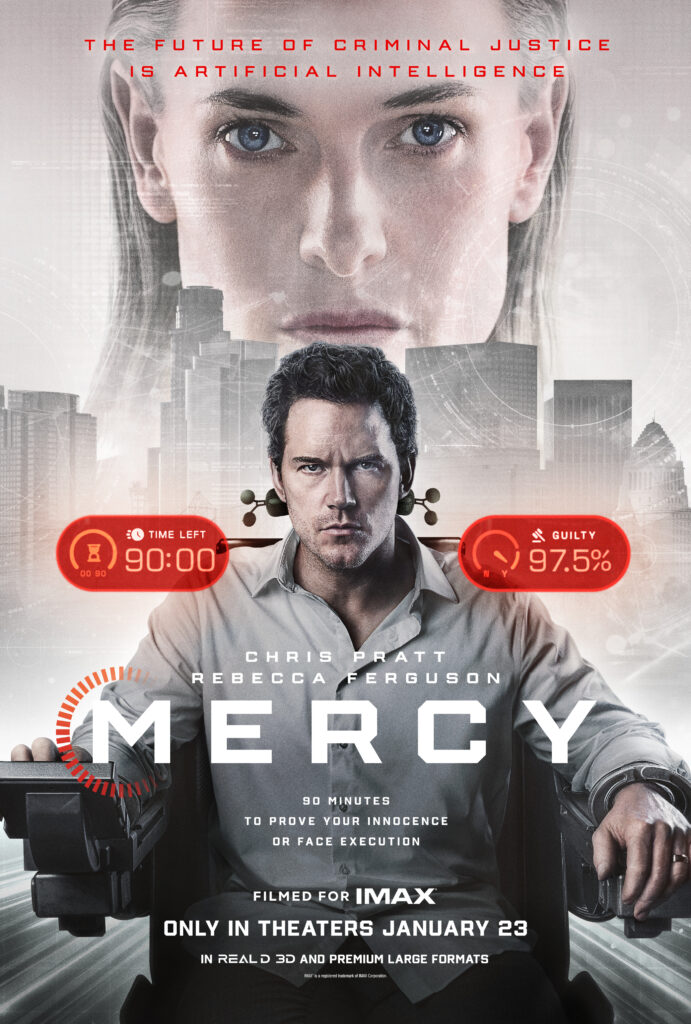
The clock starts; the film’s timer is set. At least we know how long we have before we can get dinner.
Overview
The face-on interview camera shot set the tone for a lot of the action to take place in one room and for the main actors to carry most of the film, perhaps a hallmark of director Timur Bekmambetov. The “screenlife format” puts a lot of pressure on the actor to deliver each individual plot point with maximum impact.
The legal ramifications are kind of tricky and play for a weak case for an AI court. It’s rather flimsy for the court to conduct its business over a series of phone calls. This assumes that everyone will answer if they see a call from the Mercy Court.
Acting
Chris Pratt does a surprisingly decent job hacking it for this film. We, the viewing audience, are left to guess at the level of technological progression in the short hop into the future in which this film is set. Chris seems quite adept at using this future tech during his dystopian trial. Rebecca Ferguson, as the face of Mercy Court, navigates the script with skill. But the narrative choices written on the page and executed through digital glitching were choppy and disjointed. It must have been a chore for Ferguson to bring this performance to a place that would have been standout.
“Writing, of course, is writing, acting comes from the theater, and cinematography comes from photography. Editing is unique to film. You can see something from different points of view almost simultaneously, and it creates a new experience.”
Stanley Kubrick
Production, Writing, and Filmmaking
Ugh. The action scenes that happened outside the Mercy Court were as relevant as expected. When screenlife is used in filmmaking, we are often dialogue-splained through all of the major exposition with dreadfully few non-screen camera shots.
Final Rating: 4/10
I found the screenlife format overly cumbersome and lacking; the acting was unconvincing, and the script needed improvement.
Spoilers
Click to reveal thoughts on the ending …
The partnership between Chris and the AI in the buddy cop scenario was quite predictable. Another thought I had was that Chris might lie to prolong the trial, or that the building’s emergency power would ultimately be insufficient to eliminate him, leading to a not-guilty verdict.
I argue that we did not really get to see an AI court in action. There were choices made by the AI that felt overtly human, and the digital glitching left us to assume that even in the future, we won’t have hallucination-free AI.